How to use a portable tire inflator
Match the inflator's PSI rating to your tire's recommended pressure, most passenger cars need 30 to 35 PSI cold, attach the chuck to the valve stem, set the target pressure if the unit has a digital display, and let it auto shut off; a compact unit like the AstroAI L7 150 PSI Cordless at $23.49 covers most passenger tires.

AstroAI L7 Tire Inflator Portable Air Compressor,150 PSI Cordless Bike Pump
150 PSI / cordless
The main piece of gear for this job. The rest of what you need is below.
How to use a portable tire inflator (step by step)
- Check your tire's recommended cold pressure, listed on a sticker inside the driver's door jamb, not the number molded on the tire's sidewall, which is the tire's maximum, not the recommended pressure.
- Remove the valve stem cap and check the current pressure with a separate digital gauge, or the inflator's own gauge if it has one, before you start.
- Attach the inflator's air chuck firmly onto the valve stem until the hiss of leaking air stops.
- If the inflator has a digital display, set the target PSI and let it run until it auto shuts off; if not, inflate in short bursts and check the pressure with a gauge between bursts.
- Remove the chuck and check the final pressure with a gauge, since a chuck-mounted reading can be slightly off from a standalone gauge.
- Replace the valve stem cap to keep dirt and moisture out.
12V plug-in, cordless battery, or a heavy duty compressor: which do I need?
A 12V DC inflator, like the AstroAI Tire Inflator Portable Air Compressor at $23.99, plugs into the car's cigarette lighter socket and draws power from the running vehicle, which means unlimited runtime but you have to stay near an outlet with the engine on.
A cordless battery unit, like the AstroAI L4 Cordless at $39.99 or the Fanttik X9 Classic 150 PSI Cordless at $39.99, runs off its own rechargeable battery, which is more convenient for topping off a tire away from the car, at the cost of a limited runtime per charge.
A heavier 12V unit rated with a CFM airflow number, such as the VEVOR 10.6 CFM at $109.83, fills a tire noticeably faster and holds up better for repeated use across multiple tires, which matters more for a truck or trailer with larger tires than for topping off a single passenger car tire occasionally.
What PSI rating do I actually need?
Most portable inflators are rated well above what a passenger tire needs, commonly 150 PSI or higher, which is more about giving headroom and a faster fill rate than about the tire's actual target pressure. Passenger car tires typically run 30 to 35 PSI cold, while truck and some SUV tires can call for 35 to 50 PSI or more depending on load, so check your door jamb sticker rather than assuming a single number applies to every vehicle.
A unit rated at 150 PSI, like most compact cordless models, has plenty of headroom for any passenger vehicle; only larger truck, trailer, or off-road tires running higher recommended pressures need to check that the inflator's max rating clears their target.
Why does the inflator's gauge sometimes disagree with a separate gauge?
A chuck-mounted or built-in gauge reads pressure right at the connection point while air is flowing, which can show a slightly different number than a standalone gauge reading the tire once it is disconnected and settled. This small gap is normal, but if you want the most accurate final number, double check with a dedicated digital gauge like the AstroAI 150 PSI gauge at $6.58 after you finish inflating.
How long does it take to inflate a tire with a portable unit?
Fill time depends on the inflator's airflow rate, the tire's volume, and how far off the current pressure is from the target. A small unit filling a passenger tire from slightly low to its target pressure often takes only a minute or two, while filling a larger truck tire from flat, or filling several tires in a row, takes considerably longer and can strain a compact cordless unit's battery or its motor's duty cycle rating.
What should I check before buying a portable inflator?
- PSI rating clears your vehicle's highest recommended tire pressure with margin
- 12V plug-in for unlimited runtime, or cordless battery for portability away from the car
- A digital display with auto shut-off, so you do not have to babysit the gauge
- CFM airflow rating if you regularly fill larger truck or trailer tires
What you need to inflate a tire on the road
Prices change often.

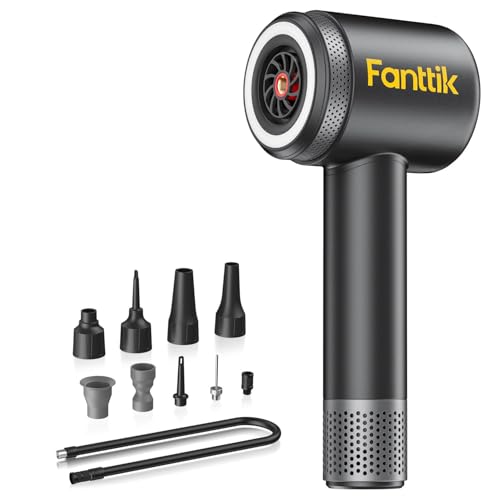 Fanttik X9 Classic 2-IN-1 Tire Inflator/Blower, 150PSI Cordless Air Pump150 PSI / cordless$39.99Check price on Amazon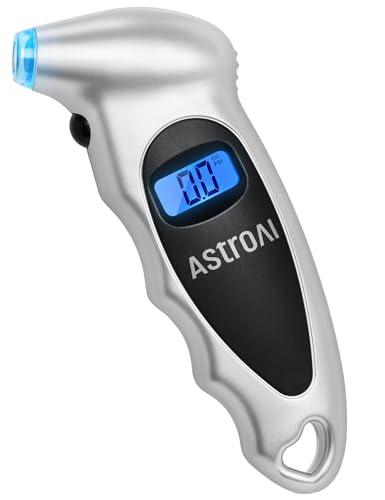
Frequently asked questions
What PSI should I actually inflate my tires to?
Use the number on the sticker inside your driver's door jamb, not the number molded on the tire's sidewall, which is the tire's maximum rated pressure, not the vehicle's recommended pressure. Most passenger cars call for 30 to 35 PSI cold, while trucks and some SUVs run higher depending on load.
Should I check tire pressure when the tires are warm or cold?
Cold, meaning before the car has been driven that day or after it has sat for at least a few hours. Driving heats the air inside a tire and raises the reading, so checking or inflating right after a drive can give you a false sense of the tire's actual resting pressure.
How much faster is a 12V plug-in inflator than a cordless one?
It depends more on the specific unit's airflow rating, measured in CFM, than on whether it is 12V or cordless, since both types range from slower compact units to faster higher-CFM units. A 12V unit does have the advantage of unlimited runtime since it draws straight from the running car rather than a battery that can run low.
Can I use a portable inflator on a completely flat tire?
Most compact 150 PSI class inflators can, though it takes longer than topping off a slightly low tire and puts more strain on the unit's motor. For a tire that has gone fully flat, check for a puncture or damage with a tire repair kit or a shop visit rather than just reinflating and driving off.
Do I need a separate tire pressure gauge if my inflator has a display?
It is still worth having one. A built-in gauge reads pressure at the connection point while air is flowing, which can differ slightly from a standalone digital gauge's reading once the tire has settled. A separate gauge, like the AstroAI 150 PSI Digital Tire Pressure Gauge at $6.58, is a cheap way to double check the final number.
Does a cordless inflator lose power as its battery runs down?
Some cordless units do slow down noticeably as their battery depletes, since the motor draws less current at a lower voltage, while others hold a steadier output until the battery cuts out entirely. Checking the specific model's rated runtime, often stated in minutes of continuous use per charge, gives a better sense of how many tires it can realistically fill on one charge than assuming performance stays constant throughout.