Best jump starters
The GOOLOO A3 is a 12V 3000A jump starter with a built-in air compressor for $69.96, which is why it is our overall pick for drivers who want one unit that covers both a dead battery and a low tire.

GOOLOO A3 12V 3000A Portable Jump Starter with Air Compressor
3,000A peak / air compressor
The GOOLOO A3 12V 3000A Portable Jump Starter with Air Compressor pairs a 3000A-rated lithium pack with a built-in inflator, so one $69.96 unit covers a dead battery and a low tire on the same trip instead of carrying two separate tools.
The three tiers
Beginner: Best cheap jump starter
Who it is for: Drivers who want a glovebox backup for one gas sedan or crossover and do not need a compressor.
 Beginner pickS ZEVZO ET03 Car Jump Starter 4000A Jump Starter Battery Pack for Up to 8.0L Gas and...4,000A peak / 8L gas / 7L diesel$53.99Check price on Amazon
The S ZEVZO ET03 is rated to 4000A peak and the listing states it covers up to an 8.0L gas or 7.0L diesel engine for $53.99. That is enough headroom for nearly any consumer gas engine and most light diesel pickups, and the price undercuts most name-brand packs by half.
Not for: Anyone who tows, runs a diesel dually, or wants a compressor bundled in should size up.
Intermediate: Best balance of power and price
Who it is for: Households with a mixed fleet, gas or a lighter diesel, who want margin above the minimum rating.
 Intermediate pickOXILAM Jump Starter 6000A for All Gas/12L Diesel, Car Battery Jumper Starter Portable...6,000A peak / 12L diesel$59.99Check price on Amazon
OXILAM rates its 6000A pack for all gas engines and up to a 12L diesel for $59.99, which is roughly double the stated ceiling of the cheapest packs for ten dollars more. That margin matters in cold weather, when cranking loads rise and a jump starter sized right at the limit can struggle.
Not for: If you only ever start one small gas car, the extra capacity is unused weight and cost.
Expert: Best premium build
Who it is for: Buyers who want a name-brand safety record and do not mind paying for it.
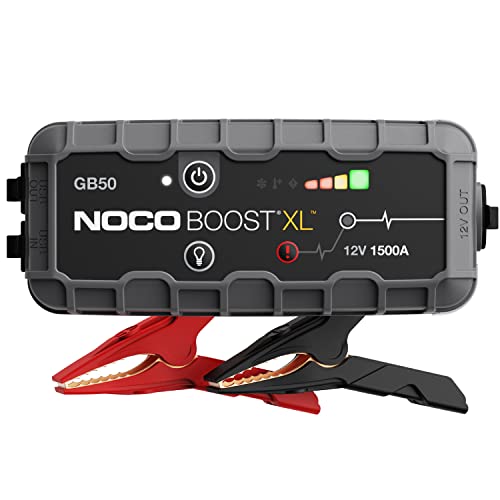 Expert pickNOCO Boost GB50 1500A UltraSafe Jump Starter, 12V Lithium Battery Booster1,500A peak$142.45Check price on Amazon
The NOCO Boost GB50 is rated 1500A peak for $142.45 and is marketed by NOCO as UltraSafe. It is a smaller peak-amp number than the budget packs above, so match it to your actual engine size rather than assuming premium means bigger.
Not for: Owners of larger diesel trucks who need a stated multi-liter diesel rating should look at a heavy-duty pack instead; the GB50 is built for gas cars and smaller engines.
| Model | Price | Key spec | Best for |
|---|---|---|---|
| TREKURE 4000A | $35.99 | 16800mAh, up to 8L gas / 6.5L diesel | Tightest budget |
| S ZEVZO ET03 | $53.99 | 4000A, up to 8.0L gas / 7.0L diesel | Cheap daily driver backup |
| OXILAM 6000A | $59.99 | All gas / up to 12L diesel | Mixed gas and diesel household |
| GOOLOO A3 | $69.96 | 3000A with air compressor | One unit for battery and tires |
| GOOLOO GP3000 | $59.96 | 3000A, up to 9L gas / 7L diesel | Lithium jump box alternative |
| NOCO Boost GB50 | $142.45 | 1500A, UltraSafe spark-proof clamps | Premium build quality |
| WOLFBOX MV24A | $184.99 | 4000A with 160PSI compressor | Jump starter plus full inflator |
How many peak amps do I actually need?
As a rough rule, gas engines need about 1 amp of cranking current per cubic inch of displacement, and diesels need roughly double that because of higher compression. A liter is about 61 cubic inches, so a 3.5L gas V6 is around 210 cubic inches, or roughly 210 amps of real cranking load. Peak amps on a jump starter box is not a standardized rating the way cranking amps on a car battery is, so treat it as a rough marketing number.
The more reliable comparison is the maker's own stated engine size, which is why every product above lists it directly: 'up to 8.0L gas' or '12L diesel' tells you more than a bare peak-amp figure. Use our jump starter size calculator to translate your engine's liters into a target rating before you buy.
Do I need a jump starter with a built-in air compressor?
A combo unit like the GOOLOO A3 or WOLFBOX MV24A saves a separate purchase if you also want a 12V inflator in the car, and it means one battery to keep charged instead of two. The tradeoff is a larger, heavier unit and a compressor that is usually slower to fill a full-size tire than a dedicated heavy-duty inflator.
If tire pressure is an occasional top-off job and jump starts are the priority, a compressor-free pack like the S ZEVZO ET03 or OXILAM keeps the price and size down. If you already carry a separate inflator, skip the combo units and put the savings toward more diesel-rated capacity.
Is a lithium jump starter safe to leave in a hot car?
Lithium jump starter packs use the same cell chemistry as phone power banks, and manufacturers publish a storage temperature range that a closed car in direct sun can exceed in warmer seasons. Repeated heat soak shortens the pack's life and, in rare cases, can trigger a safety shutdown or swelling.
Keep the unit in the cabin rather than the trunk in hot climates when you can, and check the maker's storage range in the manual before leaving it in the vehicle for long stretches. See our guide on jump starter storage in hot cars for the specifics.
How we chose
Every pick here was researched from published specifications and verified owner reviews, not hands-on testing. We compared each listing's stated peak-amp rating and, where given, the maker's own gas or diesel engine-size coverage, since that number is more consistent across brands than peak amps alone.
We favored packs that state a specific engine size (liters of gas or diesel) over ones that list only a peak-amp figure with no context, because peak amps are not standardized between manufacturers. Price was compared at the listed amount at the time of writing and will drift with Amazon pricing.
Buying tips
What is the difference between peak amps and cranking amps?
Cranking amps (CA) and cold cranking amps (CCA) are standardized battery ratings measured at fixed temperatures. Peak amps on a jump starter is a manufacturer-chosen burst figure with no industry standard, so a 6000A box from one brand is not necessarily stronger than a 4000A box from another. Compare stated engine coverage instead when it is available.
Should I buy based on mAh capacity?
Milliamp-hour capacity (mAh) tells you how many jump starts you get before recharging, not how strong any single jump is. A 27000mAh pack can deliver more total starts over a week of use than a 16800mAh pack of the same peak-amp rating, which matters if you are equipping a fleet vehicle or a car that sits for a while.
Do I need 12V/24V dual voltage?
Only if you run equipment with a 24V electrical system, common on some larger commercial trucks and construction equipment. Passenger cars, pickups, and most consumer diesels run 12V systems, so a 12V-only pack like the ones above is the right fit for a typical driveway.
How often should I recharge a jump starter that is not in use?
Lithium packs self-discharge slowly, but manufacturers generally recommend a top-off charge every few months in storage. Check the indicator lights before a road trip rather than assuming a pack that has sat all season is still at full charge.
Other options across the price range
An even spread from budget to premium. Prices change often.
 TREKURE Portable Car Battery Jump Starter 4000A 16800mAh Jump Box, Car Battery Jumper...4,000A peak / 8L gas / 6.5L diesel / 16,800mAh$35.99Check price on Amazon
 AUTOONE Car Jump Starter 6000A Battery Booster, Portable Battery Pack for All Gas 10L...6,000A peak / 10L diesel$50.56Check price on Amazon
 160PSI Jump Starter with Air Compressor, 12V Car Battery Jump Starter Power Bank(All...12L diesel / 160 PSI / air compressor$59.99Check price on Amazon
 HPBS 5000A Jump Starter with Air Compressor, Portable Car Battery Jump Starter with 150...5,000A peak / 10L gas / 8L diesel / 150 PSI / air compressor$69.98Check price on Amazon
 AstroAI M10 6000A Car Jump Starter with Air Compressor, 12V Jump Box6,000A peak / air compressor$89.97Check price on Amazon
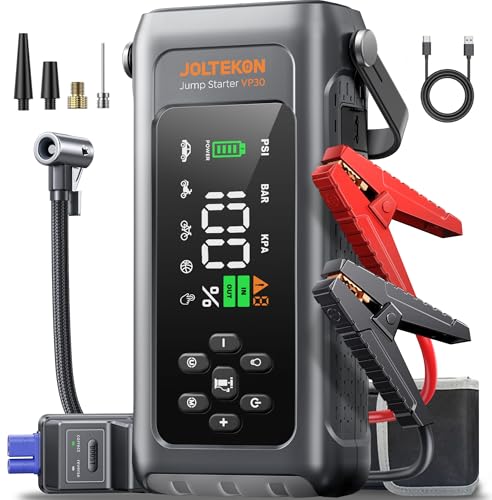 JOLTEKON Car Battery Jump Starter with Air Compressor 4500A 150PSI, Car Jumper Starter...4,500A peak / 9L gas / 8L diesel / 150 PSI / air compressor$99.99Check price on Amazon
Frequently asked questions
What size jump starter do I need for a V8 truck?
Look for a pack whose listing states coverage for at least your engine's displacement in gas liters. A 5.7L V8 is a common gas truck engine, and packs like the OXILAM 6000A (rated for all gas engines) or S ZEVZO ET03 (up to 8.0L gas) both clear that with room to spare. Use the jump starter size calculator to confirm your specific engine.
Can I use a car jump starter on a motorcycle battery?
Most 12V jump starter packs work on motorcycle batteries as long as the clamps fit the terminal size and the pack has reverse-polarity protection, but always check the maker's documentation first since some units are tuned for larger battery banks and can deliver more current than a small motorcycle battery is built to accept.
How long does a lithium jump starter last on the shelf?
Most lithium jump starter packs hold a usable charge for several months without topping off, thanks to low self-discharge lithium cells, but heat accelerates capacity loss. Check the charge indicator every season and top off before winter, when cold weather both raises cranking load and reduces battery output.
Is a higher peak-amp number always better?
Not necessarily, since peak amps are not standardized between manufacturers the way cranking amps are for car batteries. A stated engine-size coverage, like 'up to 8.0L gas / 7.0L diesel,' is a more consistent way to compare packs across brands than the peak-amp figure alone.
What is the difference between a jump starter and a battery charger?
A jump starter delivers a short high-current burst to start an engine on a dead battery and is meant for occasional emergency use. A battery charger restores a battery's full charge over hours and is meant for routine maintenance. See our jump starter versus battery charger comparison for when you need each.