How to use a jump starter safely
Clamp red to the dead battery's positive terminal first, then black to a bare metal ground point away from the battery, never the negative terminal itself; a compact lithium jump starter like the GOOLOO GP2000 at $49.96 can start most cars in seconds once connected correctly.

GOOLOO GP2000 Jump Starter - 12V 2000A Car Battery Jumper Starter Portable
2,000A peak
The main piece of gear for this job. The rest of what you need is below.
What order do the clamps go on in?
- Turn the jump starter off and make sure the vehicle's ignition is off before connecting anything.
- Connect the red, positive, clamp to the dead battery's positive terminal, marked with a plus sign or a red cover.
- Connect the black, negative, clamp to a bare, unpainted metal point on the engine block or chassis, away from the battery itself, not to the battery's negative terminal.
- Turn the jump starter on if it has a power switch, then start the vehicle.
- Once the engine starts, remove the black clamp first, then the red clamp.
- Turn the jump starter off and let it sit before recharging it or reconnecting it to anything else.
Why does the ground clamp go on bare metal, not the battery itself?
A dead or weak battery can vent a small amount of hydrogen gas, especially a lead-acid battery under load. Connecting the final clamp directly at the battery's negative terminal risks a spark right at that vent point. Clamping to a bare metal point on the engine block or chassis instead moves that final connection point away from the battery, so any spark from making the connection happens somewhere gas is not concentrated.
This is standard practice with a traditional set of jumper cables between two cars and it applies the same way with a portable jump starter's clamps.
What if I get the polarity backwards?
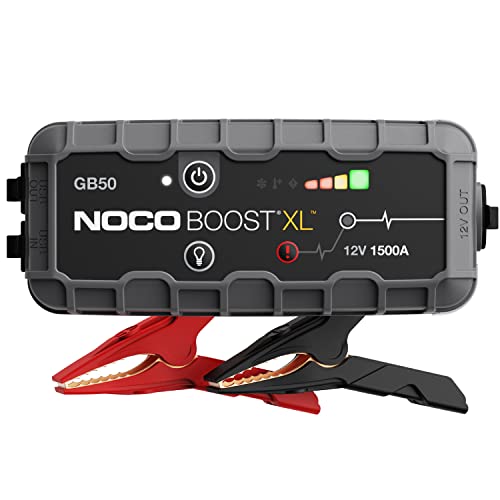
Most modern jump starters, including lithium units like the AstroAI S8 and the NOCO Boost GB50 UltraSafe at $142.45, include reverse polarity protection that simply refuses to send power if the clamps are connected backwards, usually shown with a warning light or alert tone rather than any spark or damage. Older or bare-bones units may not have this protection, so it is worth checking the specific model's spec sheet for reverse polarity protection before assuming it is built in.
Either way, double-checking red to positive and black to negative-side ground before you turn the unit on is worth the extra ten seconds regardless of what protection the unit claims to have.
How do I match the jump starter to my engine?
Jump starter peak amp numbers are not a standardized rating between brands, so two units both listed at 5000A peak amps are not guaranteed to perform identically. The more reliable number to compare is the engine size the maker states the unit is rated for, commonly phrased as something like up to 10L gas or 8L diesel. As a rough rule of thumb, cranking load runs about 1 amp per cubic inch of engine displacement for gas engines and roughly double that for diesel, with more required in cold weather; 1 liter of displacement equals about 61 cubic inches.
A small car with a 2.0L gas engine, about 122 cubic inches, needs meaningfully less cranking power than a 6.7L diesel truck, about 409 cubic inches at roughly double the amps-per-cubic-inch, which is why a compact 1500A unit like the AstroAI S8 suits a sedan while a diesel truck calls for a unit rated specifically for large diesel engines.
What should I never do with a jump starter?
- Never connect the clamps backwards, even on a unit with reverse polarity protection
- Never clamp the ground lead to the battery's negative terminal itself; use a bare metal point instead
- Never leave the clamps connected to the battery for an extended time after the engine starts
- Never use a jump starter on a battery that is visibly cracked, leaking, or badly swollen
- Never charge or store a lithium jump starter in a closed car in extreme heat
How do I keep the jump starter itself in good shape?
Lithium jump starters, which is what most modern compact units use, hold their charge for months on a shelf but still benefit from a top-up charge every few months if they are not used regularly. Follow the maker's stated storage temperature range rather than leaving the unit in a hot glovebox or trunk long term, since extreme heat is harder on a lithium pack than cold is.
Jump starters sized for the job
Prices change often.
 OXILAM 24000mAh Jump Starter for All Gas & Diesel Engines, 10000A Battery Jumper...10,000A peak / 24,000mAh$149.99Check price on Amazon
 DEWALT DXAEJ14 1600 Peak Amp Jump Starter with 120 PSI Air Inflator1,600A peak / 120 PSI / air compressor$169.00Check price on Amazon
Frequently asked questions
Which clamp goes on first when using a jump starter?
Red, positive, goes on the dead battery's positive terminal first. Black, negative, goes on second, to a bare metal ground point on the engine or chassis, not the battery's negative terminal. Reverse the order when removing: black off first, then red, once the engine is running.
Can I use a jump starter on a completely dead battery?
Most jump starters can start a battery that reads very low, but a battery that will not hold any charge at all, for example one that is cracked, leaking, or has an internal short, will not start reliably even with a jump starter and should be tested or replaced rather than repeatedly jump started.
Is it safe to jump start a car in the rain?
Getting the clamps and terminals wet is not ideal for any electrical connection, but jump starters are generally used outdoors and light rain is common in practice. Dry the battery terminals off before clamping on if you can, and avoid standing in a puddle while making the connection.
Do I need to turn the jump starter off before connecting the clamps?
Yes, most manufacturers recommend making all clamp connections before switching the unit on, then switching it on right before you start the vehicle. This reduces the chance of a spark occurring exactly while you are handling the clamps.
How long can I leave a jump starter connected after the car starts?
Only as long as it takes to disconnect it, generally under a minute. Once the engine is running, the alternator takes over charging, so there is no reason to leave the jump starter's clamps attached, and doing so unnecessarily risks an accidental short or the car's electrical system feeding back into the unit.
Can I use a jump starter to power other devices, not just start a car?
Many compact jump starters double as a USB power bank and some, like models with a built-in air compressor such as the DEWALT DXAEJ14 at $169.00, also inflate tires. Using these extra features does draw down the same internal battery the unit uses to start your car, so it is worth recharging it after heavy use of any secondary feature, not just after a jump start.