Best roadside emergency kits
The AUTODECO Car Emergency Roadside Assistance Kit bundles jumper cables with a tire inflator for $34.18, covering both a dead battery and a low tire in one mid-priced kit, which makes it the pick for most drivers.

The AUTODECO Car Emergency Roadside Assistance Kit pairs jumper cables with a tire inflator for $34.18, addressing the two most common roadside scenarios, a dead battery and a low tire, in one mid-priced kit rather than a basic cable-only set.
The three tiers
Beginner: Best cheap emergency kit
Who it is for: Drivers who want basic jumper cables and roadside tools in the trunk without much expense.

The AUTODECO Car Roadside Emergency Kit is a portable safety kit for $21.99, giving a new driver or a second vehicle basic breakdown coverage at one of the lowest prices in this category.
Not for: If you want a kit with more pieces or a built-in air compressor, step up to a more complete kit.
Intermediate: Best mid-size kit
Who it is for: Drivers who want a broader set of tools than the cheapest kits without paying for a premium survival-focused kit.

The LIANXIN 142 PCS Emergency Roadside Kit includes jumper cables plus a large set of additional tools and supplies for $39.99, roughly double the piece count of the cheapest kits while staying well under the price of the most complete option.
Not for: If you specifically want an air compressor included, the EVERLIT or AUTODECO combo kit below covers that need directly.
Expert: Best complete kit
Who it is for: Drivers who want the broadest coverage in one kit, including an air compressor for a low tire.
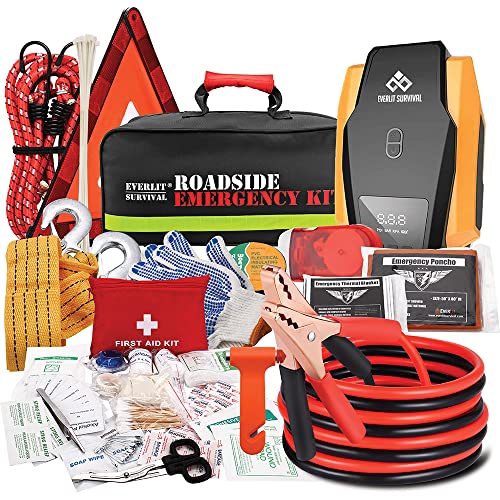
The Everlit Survival Car Emergency Kit adds a digital auto air compressor and gloves to the standard set of roadside tools for $69.95, making it the most functionally complete kit in this list rather than just the one with the most individual pieces.
Not for: Drivers who already carry a dedicated jump starter and tire inflator separately may find a simpler, cheaper kit sufficient rather than duplicating tools they already have.
| Model | Price | Key spec | Best for |
|---|---|---|---|
| AUTODECO Portable Kit | $21.99 | Basic roadside safety kit | Cheapest option |
| LIANXIN Roadside Kit | $21.99 | Jumper cables, headlamp | Budget with cables included |
| COOGEO Emergency Kit | $22.99 | Jumper cables included | Simple backup kit |
| LIANXIN Car Roadside Kit | $24.99 | Jumper cables, safety kit | Slightly larger tool set |
| AUTODECO with Inflator | $34.18 | Jumper cables, tire inflator | Combo kit with air compressor |
| LIANXIN 142 PCS | $39.99 | 142-piece roadside kit | Broadest tool selection under $40 |
| Everlit Survival Kit | $69.95 | Gloves, digital air compressor | Most complete kit |
What should a roadside emergency kit include?
At minimum, look for jumper cables, which most kits in this lineup include directly, along with basic hand tools, a flashlight or headlamp, and often reflective triangles or warning devices for visibility if you are stopped on a shoulder. Larger kits like the LIANXIN 142 PCS add more individual tools and supplies, while combo kits like the AUTODECO with inflator or Everlit add a tire inflator function on top of the basics.
Piece count alone is not the whole story; a 142-piece kit padded with small fasteners is not necessarily more useful on the roadside than a smaller kit that includes a working air compressor for a flat tire.
Do I still need a separate jump starter if my kit includes jumper cables?
Jumper cables included in an emergency kit require a second running vehicle to jump from, while a self-contained jump starter pack can start your car on its own without another vehicle present. If you are often parked somewhere isolated, a dedicated jump starter alongside your emergency kit's cables gives you a backup option that does not depend on a passerby stopping to help.
See our best jump starter guide if you want to add that capability on top of a kit's included cables.
Is a kit with a built-in air compressor worth the extra cost?
A combo kit like the AUTODECO with inflator or the Everlit Survival Kit covers a low tire in addition to the standard breakdown scenarios a basic kit addresses, which can be the difference between getting back on the road yourself and waiting for help. The tradeoff is a higher price and typically a slower, less powerful compressor than a dedicated portable inflator.
If you already carry a separate inflator, a basic kit without one, like the AUTODECO Portable Kit or LIANXIN Roadside Kit, avoids paying twice for the same function.
How we chose
Every kit here was researched from published Amazon specifications and verified owner reviews, not hands-on testing during an actual roadside breakdown. We compared stated contents (jumper cables, tools, lighting, inflator) against price rather than piece count alone, since a higher piece count does not always mean more functionally useful contents.
We favored kits that state specific included tools, like jumper cables, gloves, or a digital air compressor, over listings with vague or unlisted contents. Prices reflect the listed amount at time of writing.
Buying tips
Should I buy the cheapest kit or a more complete one?
A cheap kit covers the basics: jumper cables and simple tools, which handles the most common roadside scenario, a dead battery. A more complete kit like the Everlit adds a tire inflator and gloves, useful if you want one kit to cover more of the situations you might actually run into.
Do I need to supplement my kit with a first aid kit?
Most roadside emergency kits in this category focus on vehicle breakdown tools rather than medical supplies, so check your specific kit's contents list and add a separate first aid kit if one is not included and you want that coverage.
How often should I check what is in my emergency kit?
Check jumper cable connectors for corrosion, and flashlight or headlamp batteries for charge, at least once or twice a year, since a kit that has sat in a hot or cold trunk for a long stretch may have degraded components even if it was complete when purchased.
Other options across the price range
An even spread from budget to premium. Prices change often.


 S ZEVZO ET03 Car Jump Starter 4000A Jump Starter Battery Pack for Up to 8.0L Gas and...4,000A peak / 8L gas / 7L diesel$53.99Check price on Amazon
 OXILAM Jump Starter 6000A for All Gas/12L Diesel, Car Battery Jumper Starter Portable...6,000A peak / 12L diesel$59.99Check price on Amazon
 AstroAI S8 Ultra 12V 4000A Lithium Jump Starter Up to All Gas/12L Diesel4,000A peak / 12L diesel$72.18Check price on Amazon
Frequently asked questions
What is the most important item in a roadside emergency kit?
Jumper cables address the single most common roadside failure, a dead battery, and every kit in this lineup includes them. Beyond that, a flashlight or headlamp for visibility and working in the dark is the next most broadly useful item across the kits compared here.
Does a roadside kit replace the need for a dedicated jump starter?
Not fully. Jumper cables in a kit require a second vehicle to jump from, while a standalone jump starter pack works without one. If you are frequently in isolated areas, pairing a kit with a self-contained jump starter, covered in our best jump starter guide, adds a backup that does not depend on another driver stopping.
How much should I spend on a roadside emergency kit?
It depends on how much you already carry separately. A basic kit around $20 to $25 covers jumper cables and simple tools; a combo kit near $70, like the Everlit, adds an air compressor and gloves for drivers who want broader coverage in one purchase rather than assembling separate tools.
Are the tools in a cheap emergency kit reliable?
Quality varies by brand and price point, and none of these listings have been hands-on tested here; treat a budget kit as coverage for common scenarios like a dead battery rather than assuming heavy-duty performance from every included tool. Owner reviews on the specific listing are the best signal on real-world reliability.
Should I keep my emergency kit in the trunk year-round?
Yes, that is the intended storage location for most of these kits, but extreme heat or cold can affect battery-powered components like a flashlight or a kit's air compressor over time. Check those components periodically rather than assuming a kit stored for years is still fully functional.