4K vs 2K dash cam
A 4K dash cam like the VIOFO A229 Pro ($269.99) records at roughly 32 Mbps and resolves license plates and street signs more reliably than a 2K model like the VIOFO A119 V3 ($119.99) at roughly 16 Mbps, but the 4K file eats storage about twice as fast.
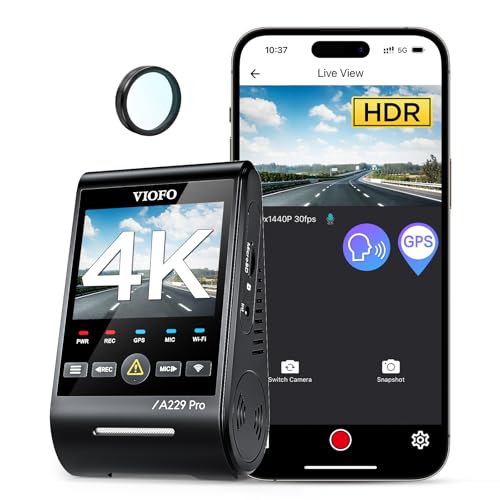
VIOFO A229 Pro 4K HDR Front Dash Cam, STARVIS 2 Sensor, 5GHz Wi-Fi
4K / front only / Wi-Fi
Drivers who want plate-level detail and are fine buying a bigger SD card
Verdict: Choose 4K if plate and sign legibility matters to you, especially at highway speed or in low light, and you are willing to buy a bigger or higher-endurance card. Choose 2K if you want a smaller, cheaper camera with a longer recording window per gigabyte and your main goal is proving fault, not reading fine detail.
The two sides
- 4K dash camVIOFO A229 Pro 4K HDR Front Dash Cam, STARVIS 2 Sensor, 5GHz Wi-Fi4K / front only / Wi-Fi$269.99Check price on Amazon
 2K dash camVIOFO A119 V3 Dash Cam, 2K Front Recording, GPS, True HDR Car Dashcam2K / front only / GPS$119.99Check price on Amazon
4K dash cam
Best for: Drivers who want plate-level detail and are fine buying a bigger SD card
- Roughly 32 Mbps bitrate resolves license plates and road signs at greater distance
- STARVIS 2 sensor pairs with 4K detail for sharper low light footage
- Best resolution available for insurance and police review of fine detail
Drawbacks: Uses about twice the storage of a comparable 2K setting for the same clip length Higher price point than an equivalent 2K single-channel camera
2K dash cam
Best for: Drivers who want a smaller file size and a lower price with still-solid detail
- Roughly 16 Mbps bitrate means close to double the recording time per gigabyte versus 4K
- Lower price point while still recording well above standard 1080p detail
- Smaller camera body in this model, which is easier to hide behind the mirror
Drawbacks: License plates at highway distance or at night are less consistently readable than on 4K Less headroom for cropping or zooming into footage after the fact
| 4K | 2K | |
|---|---|---|
| Typical bitrate | about 32 Mbps | about 16 Mbps |
| Price range in this catalog | $28.49 to $479.99 | $28.49 to $407.90 |
| 128GB card runtime, front only | about 8.3 hours | about 16.5 hours |
| Plate legibility at distance | Best in this catalog | Good, drops off sooner at range |
| File size per hour of footage | Roughly double a 2K file | Roughly half a 4K file |
| Example model | VIOFO A229 Pro, $269.99 | VIOFO A119 V3, $119.99 |
How much of a difference does 4K actually make on the road?
The gap between 4K and 2K shows up most at distance and in low light, which is exactly when you need footage the most. A 4K sensor captures roughly four times the pixel count of 1080p and noticeably more detail than 2K/1440p, which matters when you are trying to read a license plate on a car that clipped your mirror and kept driving, or a street sign that establishes exactly where an incident happened.
For everyday commuting where you mostly need to show who ran a light or who changed lanes into you, 2K already resolves more than enough detail. The VIOFO A119 V3 records at 2K and still shows plate numbers clearly on the car directly ahead or beside you, it is only at highway distance or in poor lighting that 4K starts to pull ahead noticeably.
How much more storage does 4K use?
Bitrate drives storage math directly. A 4K front channel runs around 32 Mbps versus about 16 Mbps for 2K, roughly double the data for the same length of footage. Using the standard formula (card GB times 0.93 usable times 8,000, divided by total Mbps, divided by 60), a 128GB card recording a single 4K front channel at 32 Mbps holds about 8.3 hours before the loop overwrites itself. The same 128GB card recording a single 2K front channel at 16 Mbps holds about 16.5 hours, roughly double.
That difference compounds if you add parking mode or a rear channel on top. Many 4K buyers step up to a 256GB or 512GB high-endurance card specifically to keep the loop window reasonable, which adds meaningfully to the total cost of a 4K setup beyond the camera's sticker price.
- 128GB card, 4K front only (32 Mbps): about 8.3 hours
- 128GB card, 2K front only (16 Mbps): about 16.5 hours
- 256GB card, 4K front only (32 Mbps): about 16.5 hours
Does STARVIS 2 matter more than resolution for night driving?
Sensor quality and resolution are two separate things, and a lot of buyers conflate them. STARVIS 2 is a sensor generation known for gathering more light per pixel, which improves night and low light footage regardless of whether the camera records at 2K or 4K. The VIOFO A229 Pro pairs a STARVIS 2 sensor with 4K resolution, which is why it holds detail well after dark. If you drive mostly at night in poorly lit areas, prioritize a STARVIS 2 or similar low-light sensor first, and treat resolution as the second decision.
Who should pick 2K instead of paying for 4K?
If your budget is tight, if you already own a large SD card you would rather reuse, or if your driving is mostly stop-and-go city traffic where distance detail matters less, 2K is a smart choice that saves money on both the camera and the card. The VIOFO A119 V3 at $119.99 is roughly $150 cheaper than the 4K A229 Pro and still records clean, usable footage for the vast majority of claims a daily driver will ever need to make.
More options on both sides
Prices change often.


 SANDISK 256GB High Endurance microSD Card + Adapter256GB / high endurance$69.99Check price on Amazon
Frequently asked questions
Is 4K always better than 2K for a dash cam?
Not automatically. 4K resolves more fine detail, like distant plates and signs, but it demands a bigger or higher-endurance card and costs more upfront. If your priority is proving fault in typical fender benders and lane disputes, 2K already delivers clear, usable footage. Choose 4K specifically when plate legibility at distance or in low light is a priority you are willing to pay and store for.
Do I need a special SD card for a 4K dash cam?
You need a high-endurance card rated for continuous video recording, since 4K writes more data per hour than 2K or 1080p and wears out a standard consumer card faster. Look for cards labeled high endurance or made for dash cams and security cameras, and size up to at least 128GB so the loop window does not become uncomfortably short.
Will 4K footage actually look sharper on my phone screen?
Yes, especially when you zoom in after an incident. A small phone screen compresses detail, but pinching to zoom on a 4K clip still shows a plate or sign clearly where a 2K clip would already look pixelated at the same zoom level. That zoom headroom is one of the main practical reasons drivers pay extra for 4K.
Does 4K use more power than 2K?
The difference is small in practice, since the camera's power draw is dominated by the processor and display rather than the sensor resolution alone. Expect roughly similar power draw between 4K and 2K models from the same product line, so this should not be a deciding factor between the two.
Can I record in 2K to save storage on a camera that supports 4K?
Many dual-resolution dash cams let you choose a lower recording resolution in the settings menu, which stretches your card's recording time closer to the 2K numbers even on a camera capable of 4K. Check your specific model's menu, since not every 4K camera offers a lower resolution mode.